Rajasthan · Craft · People
The Art of the Hand-Block
A wooden block. A length of cotton. Colour, judgement, rhythm — and a pair of hands that knows exactly where the next impression belongs.

The thump is rhythmic, almost hypnotic.
Wood against cloth. Thump. Move. Thump. Move. Again.
Walk through a block-printing workshop and you often hear the work before you properly see it.
A printer stands over a long padded table. In one hand is a carved wooden block, darkened from years of colour and use. Beneath it is a length of cotton that may eventually become a quilt, a dress, a cushion, or something that ends up thousands of miles away in somebody's home.
The printer lowers the block. Positions it against the previous impression. Then comes that sound again.
Thump.
The heel of the hand strikes the wood. The block lifts. A flower has appeared where a moment earlier there was nothing.
Then the printer moves a few inches along the cloth and does it again. And again. And again.
It can look almost effortless. That is what people who have spent years becoming very good at something tend to make it look like.
The machine repeats perfectly. The hand repeats beautifully.
Before the cloth, there is wood
Every printed motif begins somewhere else entirely. With a block.
A piece of seasoned wood is flattened and prepared, and the design is transferred onto its surface. Then the carver begins removing everything that isn't the pattern.
That is the strange beauty of block carving. To make a flower, you carve away the wood around the flower. To make a leaf, you remove everything that isn't the leaf. The picture slowly appears through absence.
A fine motif can contain astonishingly small channels and curves, all of which must survive being repeatedly dipped in colour and struck against fabric.
And when the block eventually wears out? The printer cannot simply click print another. Somebody has to carve another.

One pattern can be several blocks
Here is the part that is easy to miss when looking at finished cloth. A multicoloured flower isn't necessarily printed in one go.
Different parts of the design may require different blocks. One lays down an area of colour. Another establishes the outline. Another fills the details. Printers have names for these roles — terms such as gadh, rekh and datta.
But you don't need to remember the vocabulary to appreciate the difficulty.
Imagine printing a red flower. Then picking up another block and adding a black outline around it. Now imagine doing that not once, but repeatedly across several metres of cloth — and having every second impression land over the first.
There is no screen showing alignment guides. No undo button. No helpful message asking whether you are sure you want to continue.
There is the edge of the previous print. A tiny registration mark. The printer's eye. And years of muscle memory.
One cloth, many hands
When we say something is handmade, it is tempting to imagine one artisan sitting quietly somewhere, making an object from beginning to end. Textiles rarely work like that.
The block may have been carved by one person. The cloth prepared by another. Colour mixed by somebody else. The printing done by another pair of hands. The fabric washed. Dried. Cut. Stitched. Quilted, if it is becoming a rajai. Finished. Folded. Eventually packed.
What arrives as one object is often the result of several crafts meeting each other. And that is something we think is worth noticing.


Colour has its own craft
Printing in Rajasthan includes extraordinary knowledge of natural colour — plants, minerals, mordants, water, washing and sunlight all forming part of the process. Modern workshops may also use other dyes, depending on the textile, the colour and the production method.
For us the important thing is not to romanticise one as though every printed textile were made identically. We'd rather tell you how a particular piece was actually made.
Place matters here for practical reasons as much as artistic ones. Local water, climate, available materials, washing and drying conditions all influence textile making. Which means Rajasthan isn't merely the decorative inspiration behind these fabrics. It is part of the process that made them possible.
From wood to cloth
The carving
LikhaiA motif begins on seasoned wood. The carver sketches, then cuts away the negative space until only the printing surface remains. This is slow work. One slip doesn't create an interesting handmade variation. It ruins the block.
The colour
RangaiColour is prepared and transferred to a printing pad, so the raised surface of the block receives an even layer. Too much and the impression can bleed. Too little and it prints weakly. The printer learns what enough looks like.
The printing
ChapaiThe block meets cotton. It is positioned against the previous impression and struck firmly with the heel of the hand. Lift. Move. Align. Strike. Again.
Wash, dry, finish
The printed cloth still isn't necessarily finished. Depending on the process, colour may need to develop, and cloth may be washed, dried and finished before it is ready to become something else.
Only then does the fabric begin its next life — perhaps as a dress, perhaps a cushion, perhaps a rajai.
The bit that doesn't quite line up
Look closely at a hand-block print. Not from across the room. Really closely.
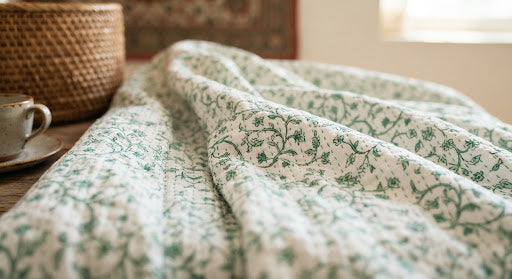
Eventually you'll find something. A leaf a millimetre higher than its neighbour. A border where one impression meets another. A patch where the colour landed slightly more heavily. A tiny shift between outline and fill.
We could call these imperfections. But that suggests the goal was mechanical perfection and somebody failed to achieve it. That isn't quite right.
They are better understood as evidence of process. They tell you: the block stopped here. A hand moved it. And the printing continued.
Perfect repetition tells you what the pattern is. Tiny variation tells you how it was made.

Why this matters to us
We started House of Rajasthan because there are things from Rajasthan that are difficult to understand from a product photograph alone. Hand-block printing is one of them.
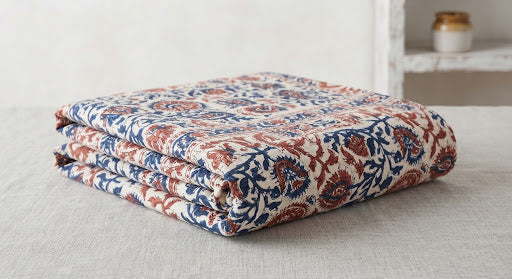
Online, you see a floral quilt. Or a printed cushion. Or a cotton dress.
But knowing how the pattern arrived there changes the way you look at it. You start noticing the border. The registration. The colour. The repeat.
And perhaps you stop expecting every handmade object to look exactly like the photograph beside the Add to Bag button. We think that's a good thing. Because if every piece were absolutely identical, there wouldn't be much need for the hands.
Someone stood at that table
Take a printed textile in your hands. Pick one motif. A flower will do.
Somebody placed the block that made that flower. Then moved their hand. And printed the next one.
Follow the row with your finger and you can almost reconstruct the movement. Print. Move. Print. Move.
Long before the cloth was folded into a parcel. Long before it arrived in Britain. Long before you chose it from a screen. Somebody stood at a table in Rajasthan and worked their way along that fabric.
There is something quietly wonderful about knowing that.

Keep looking closely
Perhaps the nicest thing about learning how something is made is that you cannot quite unlearn it.
Once you've watched block printing, printed cloth looks different. You notice repeats. You look for joins. You wonder how many blocks made a colour. You start turning over the edge to see how the print sits on the cotton.
And those tiny inconsistencies that might once have looked like faults begin to feel rather reassuring. Because they answer a simple question.
Was somebody actually here?
Yes. They were.
Carved by hand.
Printed by rhythm.
Made imperfectly enough to know somebody was there.