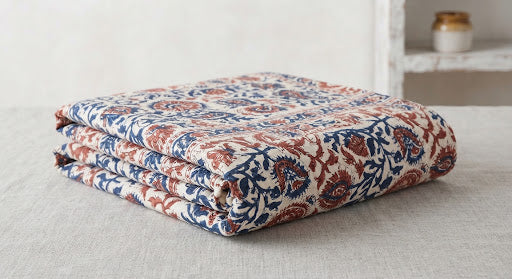
Rajasthan · Craft · Home
What Makes a Jaipuri Rajai
Light enough to fold under your arm, warm enough for a cold night, and printed one wooden block at a time. The Jaipuri rajai is a very different kind of quilt.

A Jaipuri rajai is not a duvet.
This sounds like an unnecessarily argumentative way to begin an article about bedding, but it is worth saying.
Pick one up for the first time and it can seem almost too light. There is none of the great puffed-up bulk we have become accustomed to in Britain. Fold it and you can carry it under one arm. Spread it over a bed and it sits close, rather than rising above it.
Then you sleep under one. That is when it starts to make sense.
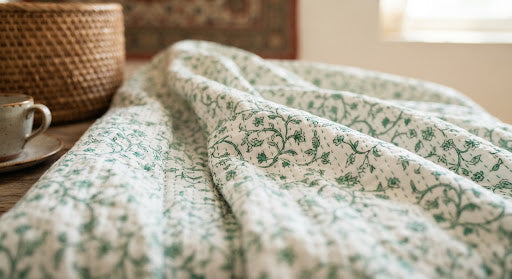
A rajai is built differently: a cotton shell around finely teased cotton filling, layered rather than heavily stuffed. The result is something surprisingly warm for its weight — soft, breathable, and much less interested in pinning you to the mattress.
It makes perfect sense in Rajasthan, where winter nights can be genuinely cold and the following afternoon can be warm again.
What surprised us was how much sense it makes in Britain too. Especially during that peculiar part of the year when the house is cold but turning the heating on still feels like admitting defeat.
A good rajai doesn't feel heavy. It simply makes the cold disappear.

The secret is inside
The warmth of a rajai doesn't come from making it enormous.
Cotton is cleaned, teased until fine, and laid carefully inside the cotton shell. That matters. A conventional duvet tends to organise its filling into compartments or channels. A rajai relies instead on a relatively fine, evenly distributed layer of cotton.
Which is why the first reaction when somebody handles one is often: that's it?
And the second reaction, usually after sleeping under it, is: oh.
There is something rather lovely about an object that doesn't look as clever as it is.
Printed by hand, not made to look hand-printed
Before there is a rajai, there is a piece of wood.
A block carver takes the pattern and cuts away everything that shouldn't print, leaving the motif standing proud. Flowers. Leaves. Buta. Paisley. Borders.
Then the printer takes over. The block meets colour. The block meets cotton. Press. Lift. Move. Again. Press. Lift. Move. Again. Across metres of cloth.
And when a pattern contains several colours, things become considerably less forgiving. Each colour can require another block, and each block must meet the pattern already printed beneath it.
There is no computer telling the printer that the flower has shifted two millimetres to the left. There is an experienced pair of hands, and an experienced pair of eyes.
The little imperfections are the point
Look closely.
You may find a flower that sits a fraction higher than its neighbour. A border might carry a little more colour at one end. Where one block impression ends and another begins, the meeting may not be mathematically invisible.
Good. That is the hand in handmade.
A machine can repeat something perfectly ten thousand times. A person repeats it beautifully. Those are not quite the same thing.

What we look for
We don't choose a rajai from a photograph alone. We want to know what is inside it.
What is the shell? What is the filling? How has it been stitched? How does the cotton feel? Does the print still have the tiny evidence of the hand that made it?
The rajais we stock are cotton through — shell and filling — and finished at around a 300 thread count.
But specifications only tell you so much. A rajai also has to pass a considerably less scientific test: would we want this one on our own bed? If the answer isn't yes, the thread count doesn't rescue it.
Jaipur has been making these for a long time
Rajai making belongs naturally to Jaipur because several crafts meet in one object. Cotton. Printing. Block carving. Dyeing. Quilting.
The finished rajai may end up on a bed, but behind it sits an entire chain of hands. Someone carved the block. Someone prepared the cloth. Someone printed the field. Someone printed the border. Someone prepared the filling. Someone stitched the quilt closed.
That is worth remembering when the finished thing arrives folded neatly in a parcel. You are looking at one object. It took several crafts to make it.
A small warning about the word king
India and Britain agree on many things. Tea, for example. What constitutes a king-size bed, unfortunately, is not one of them.
Rajai sizes follow Indian conventions, so we strongly recommend looking at the actual measurements rather than relying on the name.
| Rajai | Approx. size |
|---|---|
| Single | 60 × 90 in |
| Queen | 70 × 100 in |
| King | 90 × 108 in |
Measure the bed. Ignore your confidence.

Living with one
A rajai isn't precious in the don't touch it sense. It is supposed to be used.
It will migrate. From the bed to the sofa. From the sofa to whichever child says they're cold. Into the guest room when somebody stays. Onto the end of the bed during autumn. Back over the whole bed in January. And occasionally onto the shoulders of someone who absolutely refuses to admit that the room is cold.
That's a good life for a quilt.
Our current pieces haven't been in circulation long enough for us to tell you precisely how much their colour will soften over many years — and we'd rather tell you that than invent an answer.
The good ones get softer
There is a peculiar thing about household objects. The expensive ones aren't always the ones we become attached to.
It is usually the cup we reach for every morning. The slightly battered pan that cooks everything properly. The chair everyone chooses. The blanket somebody automatically pulls over their feet when they sit down.
A rajai can become that kind of object. The cotton relaxes. The print softens. It stops looking quite as new.
And somewhere along the way it stops being the rajai we bought from Jaipur and becomes simply: our rajai.
We think that's probably the point.

Carved in wood.
Printed on cotton.
Made to keep somebody warm.